
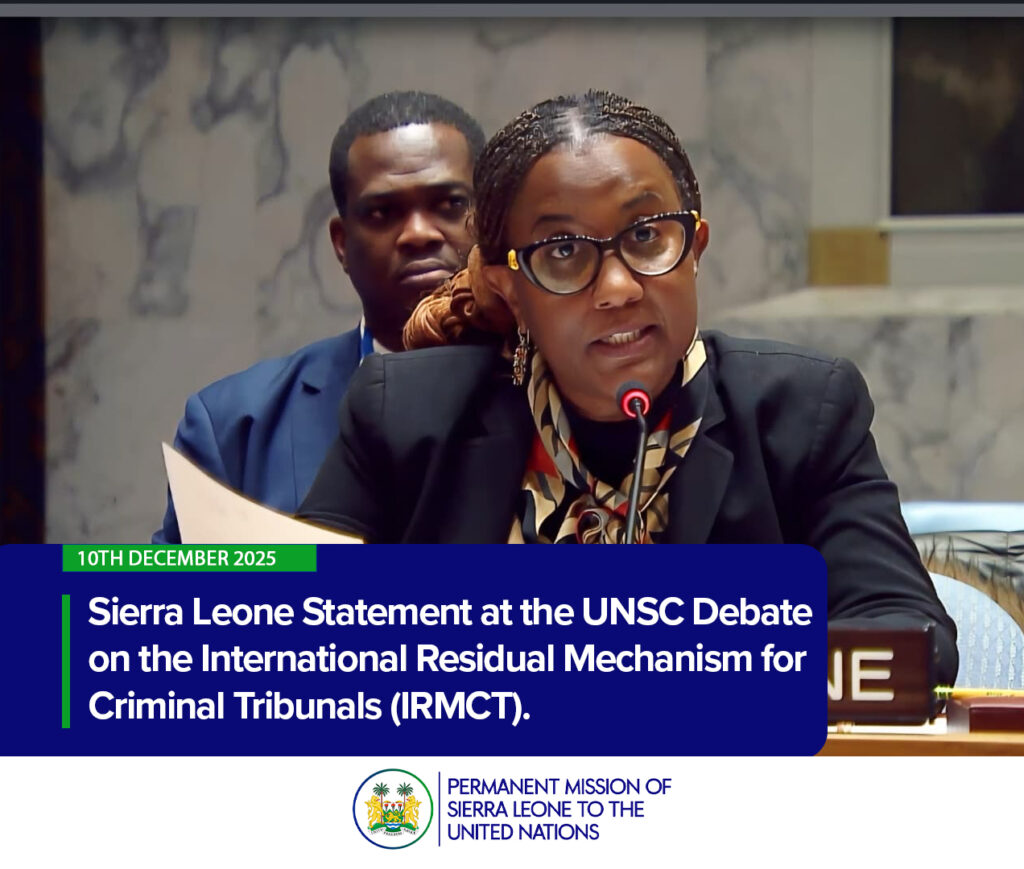
STATEMENT BY
MRS. LANLA KAMARA JOYNER
MINISTER PLENIPOTENTIARY
Madam President,
I thank Judge Graciela Gatti Santana, President of the International Residual Mechanism for Criminal Tribunals (the “Mechanism”), and Mr. Serge Brammertz, Prosecutor of the Mechanism, for their comprehensive briefings on the activities of the Mechanism covering the period 16 May 2025 to 15 November 2025.
Sierra Leone acknowledges the Mechanism’s continued efforts to realign its operations with the Council’s original vision of the Mechanism as a ‘small, temporary and efficient structure’ while exploring the options for the future transfer of its’ residual functions in response to the Council’s requests to the Secretary General in Paragraphs 11 and 12 of Resolution 2747 of 27th June, 2024.
In this regard, the staffing level of the Mechanism will decrease to 112 by 31 December 2025, even as further cuts are anticipated in 2026 to reflect the Mechanism’s progressive downsizing in line with its residual mandate, and the UN80 initiative.
Madam President,
Amid this period of transition, the Mechanism efficiently and effectively executed its residual functions, including monitoring the prosecutions of international crimes referred to national jurisdictions and providing assistance to national jurisdictions in their prosecution of war crimes, which remain the paramount residual tasks of the Office of the Prosecutor, and one in which member states rely on the Mechanism’s extensive expertise.
During the reporting period, the Mechanism’s Office of the Prosecutor received thirty requests for assistance from eight Member States relating to crimes committed in relation to Rwanda.
Concerning crimes committed in the former Yugoslavia, during the reporting period, the Office received 106 requests for assistance from four Member States and one international organization.
The Office of the Prosecutor has pioneered a collaborative approach in which national and international prosecutors work together to advance the justice process at the domestic level, and one that is state-led and state-owned.
During the period under review, the Mechanism continued to supervise the enforcement of sentences of 38 convicted persons in eight Member States, continued with conducting review and contempt proceedings; overseeing the protection of victims and witnesses including through addressing requests for the modification of protective measures, and managing the archives of the former ‘ICTR’, ‘ICTY’ and the ‘Mechanism’.
Madam President,
In view of the foregoing, Sierra Leone will make the following three points:
First, we are of the view that empowering Member States to continue the accountability process in domestic courts will be an important part of the legacy of the Mechanism; This is underscored by the fact that Rwandan authorities are still seeking to bring to justice more than 1,000 fugitive génocidaires.
Our second point is that despite notable progress, there are persisting, as well as new challenges, that face the ‘Mechanism’. The absence of sufficient enforcement States means that convicted persons continue to be housed at the UN Detention Unit in the Hague, which prevents the Mechanism from closing down the detention center and further reduce its operational costs and footprint. While enjoying greater freedom of movement, the legal status of the released and acquitted persons in Niger remains uncertain. The Mechanism faces new challenges with respect to its office premises in the Hague.
Third and finally, with respect to missing persons, while the Mechanism assisted in clarifying the fate and whereabouts of fifteen missing persons by contributing evidence that led to locating grave sites, correcting misidentifications and helping identify bodies that were in mortuaries in the former Yugoslavia region, the families in the Former Yugoslavia of more than 12,000 missing persons still do not know the fates and whereabouts of their loved ones.
We reiterate our call upon all member States to extend cooperation in addressing these challenges.
In conclusion, Sierra Leone reaffirms its unwavering commitment to the fight against impunity and to the Council’s responsibility to bring justice for victims, including women and children, that have suffered the gravest crimes against humanity, wherever and by whomever; This has been the cornerstone guiding Sierra Leone during its own tenure as Chair of the Informal Working Group for International Tribunals over the past two years.
I take the opportunity to thank the Council for entrusting Sierra Leone with this important responsibility of chairing the Working group as it navigated the Mechanism during the process of transition from a full-blown trial court to a truly residual mechanism.
I also thank the members of the Working Group for their constructive engagement.
I thank you.