
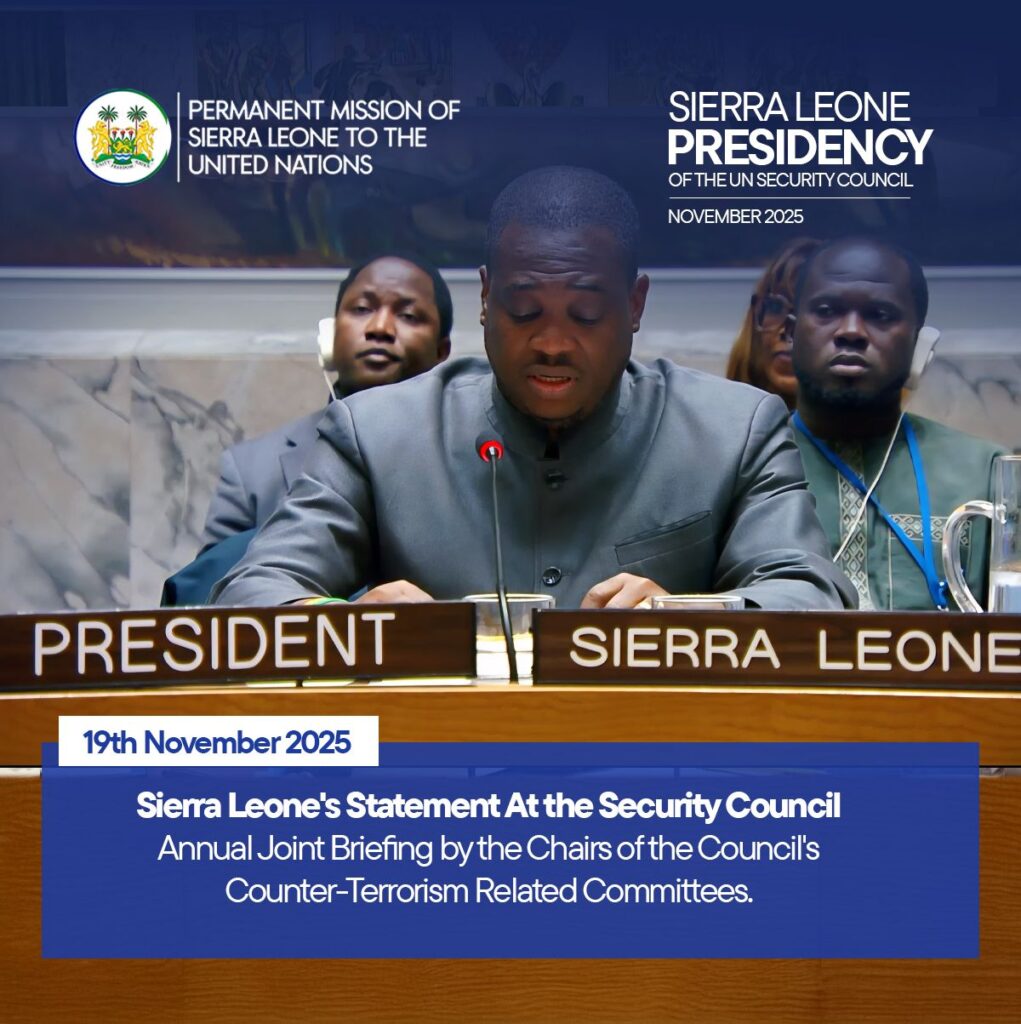
STATEMENT BY
Alan E George
Minister Counselor & Political Coordinator
1. I thank the chairs of the three counter-terrorism committees, Ambassador Sandra Jensen Landi, Ambassador Amar Bendjama and Ambassador Eloy Alfaro de Alba for their comprehensive briefings and for the steady manner in which they have guided their mandates. Sierra Leone values their leadership and the cooperation extended to all Member States throughout the year.
2. Sierra Leone remains committed to a counter-terrorism architecture that is coherent, effective, and firmly grounded in the United Nations Charter, international humanitarian law and international human rights law.
3. We welcome the presidential statement adopted on 24 January of this year, which renewed the Council’s focus on terrorism in Africa. We also reaffirm the importance of safeguarding principled humanitarian action under resolution 2664.
4. On the 1267/1989/2253 ISIL (Da’esh) and Al-Qaida sanctions regime, we underscore its central role in constraining the operational reach and financing of listed individuals and entities. Resolution 2734 strengthened analytical and due-process elements and reinforced attention to sexual and gender-based violence and information-sharing.
5. The Council’s 6 November decision on Syria showed how precise, fair, and adaptable sanctions can recognise verified behavioural changes without undermining integrity. For Sierra Leone, this confirmed the value of sanctions that are precise, fair, and adaptable, while maintaining clear expectations regarding counterterrorism and human rights obligations.
6. The Committee’s work, supported by the Monitoring Team and Member State engagement, has reinforced the regime’s credibility, though challenges remain, including ISIL and Al-Qaida activity in Africa, movements of foreign terrorist fighters, access to cash reserves, use of advanced technologies, and conditions in detention facilities.
7. Sierra Leone will continue supporting effective implementation, prioritizing measures that disrupt terrorist financing, constrain mobility, and limit access to weapons while ensuring humanitarian considerations and respect for sovereignty.
8. Turning to the 1373 Committee, resolution 1373 remains a testament to the Council’s determination to confront terrorism, which is a persistent threat to humanity. Terrorist groups and lone actors increasingly exploit drones, virtual currencies, encrypted communications, social media, and other emerging technologies.
9. Preventing terrorist access to diversified funding streams, including criminal activity and misuse of blockchain, remains essential. Sierra Leone unequivocally condemns terrorism and violent extremism in all forms and continues advancing national and regional efforts.
10. This year, we initiated an Informal Interactive Dialogue on enhancing counter-terrorism cooperation in West Africa and the Sahel and last year we enacted the National Counter-Terrorism Act of 2024, establishing a national coordination mechanism and strengthening legal, financial, and enforcement measures. This law aims to establish the National Counter-Terrorism Coordination Committee, address offenses related to terrorism and terrorism-related matters, implement enforcement measures against terrorist funds and other assets, prohibit financial support to terrorism, and address other related matters
1. We commend CTED’s assessment work, FATF and UNODC partnerships, and OCT’s technical assistance, and we call for continued logistical, financial, technical, and technological support to strengthen regional resilience. CTED’s assessments of member state counter-terrorism efforts are invaluable, as are the contributions from the Global Counterterrorism Compact Entities. We further urge all Council members to recognize and respect the importance and technical nature of these reports.
11. On the 1540 Committee, we thank Ambassador Alfaro de Alba and commend the Committee and its Experts for advancing this essential preventive mandate. Resolution 1540 remains a central pillar of non-proliferation and an integral component of Sierra Leone’s national agenda for peace consolidation and institutional strengthening. With support from VERTIC, OPCW, and UNODC, we are finalizing legislation to domesticate the Biological and Chemical Weapons Conventions, considering ratification of CPPNM and ICSANT, and strengthening national coordination across security, border, customs, intelligence, and public-health sectors.
12. We are completing a voluntary National Implementation Action Plan and welcome the Committee’s strengthened assistance-matching system, expanded voluntary peer reviews, and cooperation with the AU, ECOWAS, and UNODA. Sierra Leone stands ready for a voluntary peer review and continues to promote inclusive implementation by engaging academia, youth, women’s groups, and civil society. Ahead of the 2027 Comprehensive Review, we support an evidence-based assessment that reflects regional realities and emerging technological risks, including synthetic biology, additive manufacturing, artificial intelligence, and autonomous systems.
13. As President of the Security Council for November, Sierra Leone will continue supporting efforts to ensure the Council’s counter-terrorism and non-proliferation tools remain balanced, credible, and aligned with international law and the UN Charter. We will remain fully engaged across all three committees to ensure the Council’s counter-terrorism and sanctions instruments remain responsive to global threats.
14. I thank you.